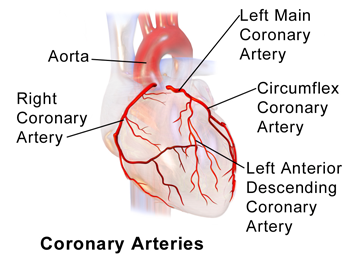
Coronary Angiography or Coronary Catheterization is a minimally invasive procedure to access the coronary flow and blood chambers of the heart using a catheter. Coronary Catheterization was first introduced in 1950s.
Angiography is derived from the Greek term ‘angeion’ meaning vessel and ‘graphein’ which means to writ. Angiography or arteriography is a technique of medical imaging where an X-Ray is taken of the heart to visualize the inner opening of the arteries, veins and the four heart chambers, right atrium, right ventricle, left atrium and left ventricle. Angiography or angiogram requires the insertion of a catheter, a thin tube into a peripheral artery.
Cardiac Catheterization Procedure
During Coronary Catheterization a patient’s blood pressure and X-Ray shadowgrams of the blood in the coronary arteries are recorded. To record the X-Ray images, a cardiologist guides a catheter through the large blood arteries till the tip of the catheter reaches the opening of the coronary arteries.
Catheters are made with a high radio density making it opaque to X-Rays allowing a clearer, blood compatible X-Ray dye to be selectively injected and mixed with the blood flowing in the artery. Without the X-Ray dye, the blood and internal structure of the heart is not clearly visible. The cardiologist activates the equipment to apply cine, a higher X-Ray dose when he/she is ready to record the diagnostic views. The diagnostic views can be saved and studied later.
How long does the Cardiac catheterization procedure take ?
Simple Coronary Angiography usually takes about half an hour to complete.
But following are the conditions during which you need to visit your doctor:
- Swelling, redness, unusual pain, or infection at the site of insertion.
- Constant or large amount of bleeding from the site of insertion.
Coronary Catheterization Facilities
Hospitals use CT Angiography or Coronary Computed Tomography Angiography, as a non- invasive method to detect blockages in the coronary arteries. 64 slice CT Angio system is used to detect dysfunctions like narrowing of the coronary arteries, soft plaque and fat.
Who should consider Coronary Cardiac CT Angiography ?
First and foremost thing for the patient, before thinking of Coronary Cardiac CT Angiography is that he should consult his doctor. Because, the usage of Coronary CTA is quite appropriate and scans during the process from X-ray exposures, there is some risk involved. It is the responsibility of the doctor that he should do careful selection of the patient so that any kind of risk involved, is reduced.
Benefits of Coronary Catheterization
- There are no remains of radiation in the body of the patient after an x-ray examination.
- Due to angiography, the need of surgery may get eliminated. If surgery is necessary then the whole procedure becomes accurate.
- X-rays generally do not have any side effects.
What to Expect After Coronary Angiography ?
After the procedure, the patient is moved to the special care area. Here he is monitored for overnight or a few hours where his movements are kept minimum for avoiding bleeding from the area where the catheter was inserted. At the site of recovery, your heart rate and blood pressure are also checked after regular intervals along with any kind of possible bleeding.
It is also possible that the area where the catheter was inserted, that area might become tender or sore for around a week’s time. A small bruise may also appear on the patient’s arms, upper thigh or neck, near the site of insertion.
To know more about Coronary Angiography cost in India keep browsing our site Medical India Tourism and to book a medical tour to India please fill the given form.
FAQs for Coronary Angiography
What are the risk factors for coronary artery disease?
Following are risk factors for coronary artery disease:
- History of heart disease in the family
- Obesity
- A diet containing a large number of saturated fats
- High cholesterol
- Inactivity
- Unstable diabetes
- Smoking
- High blood pressure
Why patients undergo Coronary Angiography?
If a patient has conditions like hypertension, smoking habit, diabetes, cholesterol, chest pain, abnormal result in stress test and family history, then the patient should undergo coronary angiography.
What benefits will patients get from Coronary Angiography?
This is a very precise non-invasive test to know about Coronary Artery Diseases. It gives high-resolution 3D images of arteries, which show earlier stages of blockages. It also measures classified and non-classified plaques.
How is this procedure performed?
First of all, a senior nurse will give you a contrast iodine dye injection through an IV in your hand or arm. This highlights your arteries. You will also have electrodes (sticky patches) on your chest to score the heartbeat rate.
Thereafter, you lie down on a bed in a tunnel-like machine called a CT scanner and relax. If a patient feels uncomfortable in the scanner’s narrow space, the doctor should be informed.
During the scan, the patient should be still and hold a breath as instructed by the doctor there. The CT machine is operated from a room, which is separated from the examination room by a glass window. An intercom system is available in the examination room to talk to each other.
Scan just takes 5 to 10 seconds but the complete procedure takes at least 1 hour.
How should a patient be prepared for this test?
The most important factor is the doctor’s consultation. The patient should give complete details related to past medical history, present complaints etc. The patient also needs to undergo a few related checkups. Thereafter, the doctor will prescribe Coronary Angiography. A doctor will also ask you to follow general preparations like the patient should be on complete fasting (no food or water intake) for 6 hours before the test. If the patient is under some medication, the same should be consulted with the doctor.
Which doctors are involved to perform CT Angiography?
Cardiologists, sometimes anesthetists, radiologists, pathologists, and specialized and senior nurses all are involved to perform CT Angiography.
What should I do after CT Angiography?
After CT angiography you can return to your daily activities. You can even drive home or work. Remember to drink plenty of water to flush the dye from your body.
How soon I will get results and what will be the treatment after that?
Your results will be ready within 24 hours and then you can meet your cardiologists to discuss your result. If you have the risk of any heart disease, the doctor will suggest a treatment option to you. Additionally, you will be recommended to make changes in your lifestyle to protect your heart.
Which precautions should we take to have a healthy heart?
Everyone should follow some precautions, which are:
- Exercise – Regular exercise helps you in maintaining a healthy life. You can decrease weight, control diabetes, blood pressure levels and cholesterol. It is important to exercise for at least 1 hour four times a week. However, always consult with your doctor before starting with any exercise.
- Food – Patients should always eat a healthy diet, which is high in vegetables, fruits, and whole grains as well as low in cholesterol, sodium, and saturated fat. This type of diet will help you in reducing weight, cholesterol, and blood pressure.
- Smoking and alcohol – These are major aspects of heart disease risks. So, if you have these habits you must quit the same at the earliest. If, you are not able to quit and need help, talk to your doctor.
- Health conditions – Patients having cholesterol, diabetes, and blood pressure should always take their medicines on time as prescribed by a doctor. Regular follow-ups with doctors are also required.
- Stress – Patients should not take stress because this can tighten blood vessels and increase risk of a heart attack. They can also attend stress management programs, stretching exercises, yoga, and meditation as all these help in reducing stress.
What kind of clothes should I wear during CT Angiography?
You will be wearing only a hospital gown and nothing above your waistline. Wearing jewelry and glasses is not allowed during the test.
What are the risks with CT Angiography?
CT scanner emits radiation. So, patients are exposed to some radiation during the test. The radiation amount will depend on the type of machine used. 320 Slice CT Scanner is an advanced machine. Risk for developing cancer is very less because of this radiation. Pregnant ladies should not undergo CT angiogram as radiation can harm the fetus. If a patient has allergic reactions because of iodine dye, inform the doctor immediately.
What is the approximate cost of Coronary Angiography and how I can get an appointment?
To know about Coronary Angiography cost and appointment, kindly contact on the below details:
Email: [email protected]
Mobile/What's app: +91 9717766080