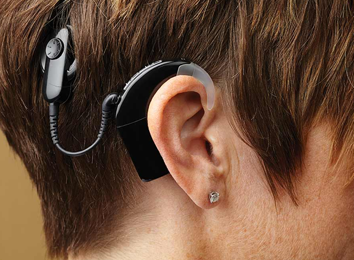
What is a cochlear implant ?
The cochlear implant device is very useful for the people who have hearing problems. This electronic device is not similar to a hearing aid as it is placed through a surgery and functions in a different way. The cochlear implant (deaf aid) is made up of some similar parts.
The surgical procedure is performed to implant the first part of the device in the bone surrounding the temporal bone (ear). The first part is made up of a receiver stimulator that first accepts, then decodes and finally sends an electric signal to the brain.
While the second part is totally an outside device. It is made of an antenna, receiver or microphone and a speech processor. The first step is to receive the sound, followed by converting the sound into an electrical signal and finally sending the sound to the inside part of the device.
Who should consider Cochlear Implants ?
The people who are hard of hearing or deaf that includes both adults and children. Intensive postimplantation therapy combines with cochlear implants enables younger children to acquire the language, social skills and speech. The age group of children is between 2-6 years and an early implantation are very helpful for the children for learning language and speech skills.
- Candidates having a strong desire to become a part of the hearing world and wants to communicate through speaking, speech reading and listening.
- Candidates having a major hearing loss in both the ears
- Candidates who do not have any other medical problem
- Candidates who had limited benefit from the use of hearing aids
Cochlear Implant Procedure
The surgical procedure starts with a careful evaluation by ENT surgeon, anesthetist, audiologist and physician. A little incision in made at the back of the ear and then the surgeon implant the receiver. The receiver is then connected to electrodes that are surgically inserted inside the cochlea. The surgery usually takes 1-2 hours to complete.
Benefits of Cochlear Implants
- People enjoy the music
- Develop more confidence in different social situations
- People speak at normal hearing level
- People start talking on the phone
- Language and speech have developed at the right age
- Communicate better with teachers, family and friends
- Hears clearly in noisy environments
- Starts enjoying the world of new sounds
- Can figure out the direction of the sound from approaching vehicles
- The success rate of cochlear implants is higher at younger ages.
Post Cochlear Implant
Rehabilitation is essential for those who have undergone cochlear implants and can be imparted at their hospital and auditory rehabilitation centers. The patient needs to know learning and relearning techniques. Hearing through cochlear implant is very different from normal hearing or hearing through hearing aids. While hearing aids amplify sounds to be heard by damaged ears, the cochlear implants directly stimulate the auditory nerve. The auditory nerve then sends signals to brain which recognizes them as sounds. Over time, the patients learns to hear and enjoy conversations, environmental sounds and music.
Bone Anchored Hearing Aid (BAHA)
This type of hearing aid is designed to use the body’s natural ability to transmit the sound through bone conduction. Firstly the sound processors picks up the sound, then transfers them into vibrations and finally sends them through the skull bone, straightaway to the inner ear.
Baha (bone conduction implant) is the most effective way of hearing and is meant for those who are deaf or have trouble with middle or outer ear.
The Baha bone induction implant can benefit children with –
- Children having problems with inner, middle or outer ear (mixed hearing problems)
- Children having total deafness in one ear (single sided sensorineaural deafness)
- Children having problems with the middle or outer ear
Invisible Hearing Aids
This invisible hearing aid fits in the canal of the ear completely without being visible. It is different from other hearing aids as it fits deeper inside in the canal. It becomes completely out of view when one looks into the Concha (ear bowl).
Cost of Cochlear Implant
The cost of a cochlear implant in India is very affordable as compared to other parts of the world.